
3 Questions Every CCO Should Be Asking About AI Use Right Now

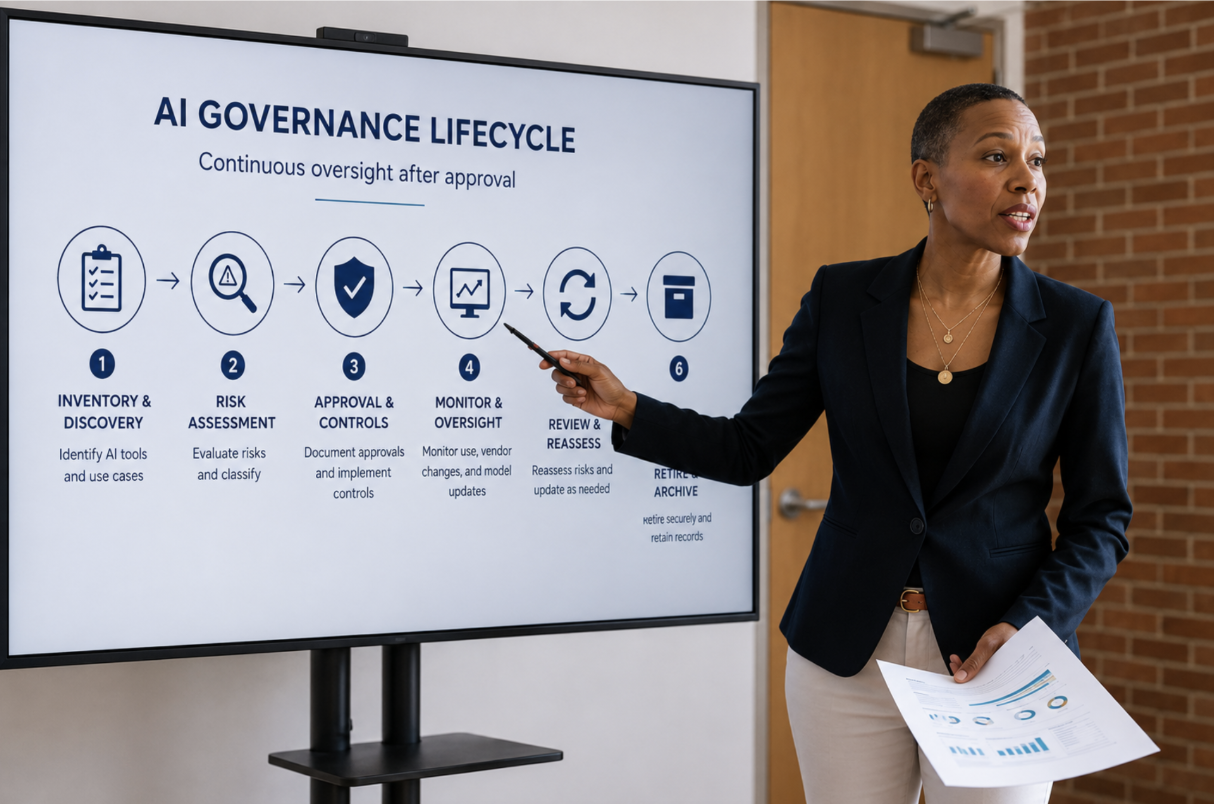
Artificial intelligence is no longer a future-state conversation for Chief Compliance Officers (CCOs) – it’s a present-day responsibility. Across investment firms, AI is being deployed in portfolio management, trading, compliance monitoring, marketing, and client communications. At the same time, regulatory expectations are accelerating – even without formal AI-specific rules. The result?A growing gap between AI …

What “Good” Looks Like: A Practical Framework for AI Governance in Investment Compliance

Artificial intelligence is no longer experimental in financial services—it’s operational. From portfolio construction to compliance monitoring, AI is now embedded across the investment lifecycle. But while adoption has accelerated, governance has not kept pace. That gap is becoming a regulatory and operational risk. Recent signals from regulators—including the U.S. Securities and Exchange Commission—make it clear: …

The New SEC Reality: Why Disclosure, Data, and Accountability Are Converging

Artificial intelligence is forcing a fundamental shift in how investment firms think about compliance. But the shift isn’t happening through brand-new regulation. Instead, it’s happening through something more subtle—and more powerful: 👉 The convergence of disclosure, data, and accountability under existing SEC frameworks. This is the new SEC reality. Firms are no longer evaluated based …

The Hidden Risk in Your Compliance Program: Where Gaps Tend to Show Up First

Most investment firms don’t fail compliance because they lack policies. They fail because of gaps—small, often invisible disconnects between what’s documented and what’s actually happening. These gaps are where risk lives. And increasingly, they’re where regulators are focusing. The U.S. Securities and Exchange Commission (SEC) has made this clear through years of examination findings:👉 Compliance …

AI Implementation in Compliance: Governance, Explainability & Audit Trails

Artificial intelligence is rapidly transforming investment compliance. From automating rule monitoring to identifying potential breaches faster and improving operational efficiency, AI offers significant advantages for compliance teams navigating increasingly complex regulatory environments. However, implementing AI in investment compliance requires more than adopting new technology — it demands thoughtful governance, transparency, and robust auditability. Regulators are …

Modernizing Onboarding & Training for Automated Oversight In Investment Compliance

Investment compliance onboarding used to be straightforward: learn the firm’s policies, memorize the escalation tree, shadow a senior analyst, and start reviewing exceptions. But as investment firms adopt more sophisticated monitoring—pre-trade checks, post-trade surveillance, exception workflows, dashboards, and rule libraries—training has to evolve. Today, the fastest path to readiness is onboarding built specifically for automated …

Designing AI Governance Frameworks for Investment Compliance Leaders

Artificial intelligence is rapidly moving from experimentation to embedded functionality across investment firms. It is being used to summarize exception logs, detect anomaly patterns, draft rule documentation, reconcile data breaks, and support surveillance workflows. For compliance leaders, this shift introduces a critical question: How do you implement AI in a way that strengthens oversight rather …

Driving Enterprise Governance: The CCO’s Influence Across the Organization

Enterprise governance is no longer confined to boardrooms or periodic audit cycles. In modern investment organizations, governance has become a continuous, data-driven discipline shaping risk posture, operational integrity, and long-term investor trust. At the center of this shift stands the Chief Compliance Officer (CCO). Once viewed primarily as a regulatory gatekeeper, today’s CCO is increasingly …

From Investment Mandate to Monitorable Rule: The Full Lifecycle of a Restriction

Turning an investment mandate into a clear, enforceable, and monitorable rule is one of the most critical challenges facing compliance and operations leaders. The process is not simply about drafting restrictions; it requires translating high-level client agreements into precise, testable criteria that withstand audits, regulatory scrutiny, and day-to-day portfolio management. This blog explores the full …

Why Investment Compliance Is a Data Problem Disguised as a Legal One

At first glance, investment compliance looks like a purely legal challenge: contracts, regulations, disclosures, and audits. But beneath the surface, compliance is fundamentally a compliance data problem. Every restriction, mandate, and reporting requirement depends on data accuracy, consistency, and accessibility. Without reliable data, even the best-drafted legal framework becomes unenforceable. In today’s environment of increasingly …